


Bad news travels faster than ever, and internal PR teams sit on the front line of every crisis. Social media outruns official statements, employees become accidental spokespeople, and one poor response can damage a brand for years. This paper explains why crisis communications training is no longer a “nice to have”, but an essential part of risk management. It explores how realistic simulations, supported by crisis comms training software can help internal teams build the skills, speed and confidence they need to respond under real pressure before an actual crisis hits.
How Crises Have Changed in the Digital Age
The core nature of a crisis has been fundamentally reshaped by digital media. Where organisations once had hours or even days to formulate a response, they now have minutes. The first challenge is the sheer speed of information. A customer complaint, an employee video, or a misleading rumour can spread globally across platforms like X (formerly Twitter) and TikTok before the internal PR team has even been alerted. False narratives are often more emotional and sensational, and studies have consistently shown they can travel faster and further than factual corrections.
This speed is complicated by the volume and noise of modern communication. A crisis no longer unfolds on a handful of news sites; it erupts simultaneously across social media, internal chat platforms like Slack, private messaging apps, and traditional media. This creates a flood of information that makes it almost impossible to “contain” a story. The focus for PR teams must therefore shift from control to credible, rapid response.
The flood of information makes it almost impossible to “contain” a story. The focus for PR teams must therefore shift from control to credible, rapid response.
Finally, digital information has a permanence that traditional media never did. Screenshots of deleted posts, archived web pages, and endless reposts mean that a poorly worded statement or a defensive reply can live forever. A single mistake can resurface years later, creating a permanent mark on a brand’s reputation and increasing the long-term risk of public distrust.
The Internal PR Team’s Expanding Role
In response to this new reality, the role of the internal PR team has expanded dramatically. Once focused primarily on media relations, teams now operate as a multi-channel crisis command centre. They are responsible for communicating with journalists, customers, employees, social media communities, and sometimes even regulators; and do it all at the same time and with a consistent message.
The distinction between internal and external audiences has also blurred. Employees expect fast and clear updates during a crisis. Silence from leadership can lead to damaging leaks, internal rumours, and a drop in morale. Furthermore, external stakeholders now pay close attention to how a company treats its people. A reassuring internal email can be screenshotted and shared publicly, becoming a powerful tool for building trust. Conversely, a lack of internal communication can be seen as evidence of a poor company culture.
This expanded role means coordination across the organisation is more critical than ever. In a crisis, the PR team must work in real-time with legal to manage risk, HR to handle employee concerns, operations to get factual updates, and senior leadership to approve statements. PR professionals are the essential bridge, ensuring that communication is fast, accurate, and aligned across all departments.
Rising Expectations from Stakeholders
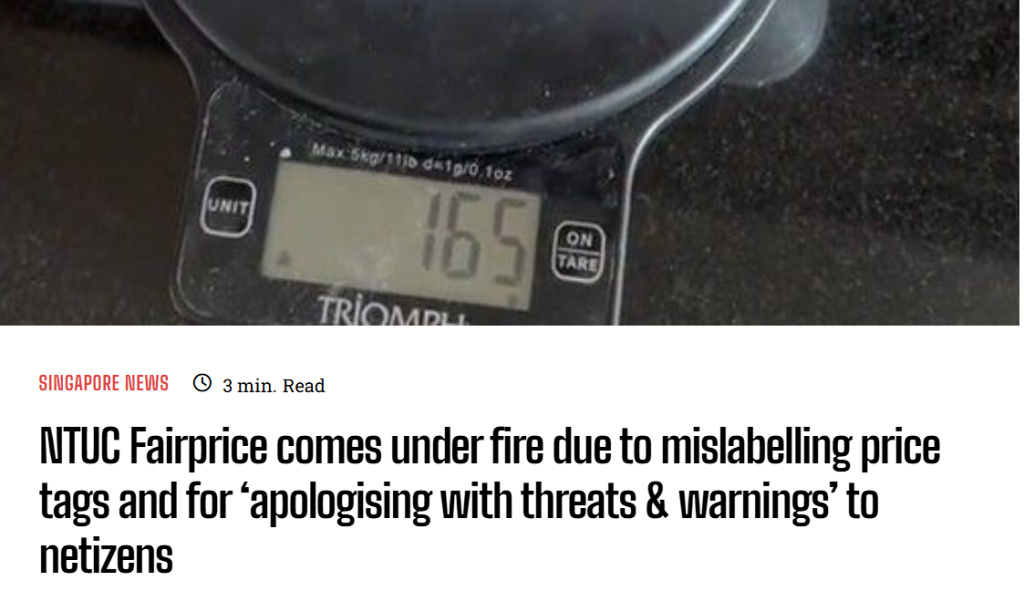
As communication has become more direct and personal, the expectations placed on organisations during a crisis have risen. Today, the public, customers, and employees expect transparency and empathy above all else. A delayed, overly legalistic, or defensive statement can cause more damage than the initial incident. People want to see that the organisation is taking the issue seriously, cares about those affected, and is taking clear steps to resolve it.
This pressure is amplified by media and influencers. Journalists still require quick official comments, but now influencers can shape public opinion long before a press release is even written. Their commentary can set the tone of the conversation online, making it even harder for a brand to establish its own narrative.
At the same time, scrutiny from regulators and investors has intensified. For publicly traded companies or those in regulated industries, a poorly managed crisis can trigger official investigations, damage investor confidence, and have a direct financial impact. These stakeholders view a company’s crisis response as a test of its governance, ethics, and overall competence.
Silence is not a response

In early 2024, the CEO of Kellogg’s sparked a massive PR backlash by suggesting that families facing record-high inflation should eat “cereal for dinner” to save money. His multimillion-dollar salary contrasted sharply with his advice for the working class. And, Kellogg’s had recently raised prices by over 12%. The company did not issue a formal apology. While the viral outrage has cooled, the damage to Kellogg’s brand sentiment remains a textbook case of corporate tone-deafness. Video Source
Why Traditional Crisis Training is No Longer Enough
Static Plans vs Dynamic Reality
For many organisations, a crisis plan exists as a detailed document such as a binder on a shelf or a file on a server. It contains contact lists, protocols, and pre-approved statements. While essential as a foundation, these static plans are not enough to prepare a team for the dynamic reality of a modern crisis. A document cannot replicate the pressure, speed, and confusion of an unfolding event.
This creates a dangerous gap between knowing and doing. A team can read a plan and understand it in theory, but they will struggle to act quickly and confidently under real stress without practice. In the heat of a crisis, questions that seemed simple on paper become major hurdles: Who has the final sign-off on a social media post at 2 AM? How do we verify information before it goes public? A lack of practice leads to slow approvals, confused roles, and mixed messages that worsen the situation.
Tabletop Exercises: Useful But Limited
Tabletop exercises, where a team gathers in a meeting room to discuss a hypothetical scenario, are a step up from a static plan. They are useful for aligning senior leaders on high-level strategy and clarifying decision-making roles. Participants can talk through their responsibilities and identify obvious gaps in the crisis plan.
However, their limitations become clear when compared to a real event. Tabletop exercises rarely simulate the true speed and pressure of a digital crisis. There is no real-time flood of social media comments, no urgent calls from journalists on a deadline, and no angry emails filling up an inbox. The discussion remains theoretical. Participants have little opportunity to practise the critical, hands-on skills of a crisis, such as writing an empathetic and accurate social media post in minutes or drafting an internal employee update under extreme pressure.
The Skills Gap in Internal PR Teams
The unique demands of a crisis require skills that are often underdeveloped in day-to-day PR work. These include real-time decision-making with incomplete information, prioritising tasks when every channel demands attention, and coordinating approvals quickly without sacrificing message discipline. These are not skills that can be perfected by reading a manual; they must be built through practice.
The problem is that most PR professionals only face a handful of major crises in their careers. This lack of exposure means that for many teams, their first real test comes when the stakes are highest. Without realistic simulations, they are forced to “learn on the job,” a high-risk approach when brand reputation is on the line. Industry reports and stakeholder feedback consistently show that while organisations are judged harshly on the quality of their crisis response, many internal teams feel under-prepared to manage the complex, multi-channel demands of a modern crisis.
The Business Case for Crisis Comms Training
The Cost of Getting Crisis Communications Wrong
An unhandled or poorly handled crisis can have devastating consequences that go far beyond negative headlines. The most immediate is the direct financial impact. Customers may boycott products, leading to lost sales, while business partners might delay or cancel contracts. For publicly-traded companies, a crisis of confidence can erase millions from its market value in a matter of hours. The damage is often worsened not by the initial event, but by a slow, defensive, or unclear communication response. A delayed apology or a statement that lacks empathy can turn a manageable problem into a financial catastrophe.
Beyond the immediate financial shock lies long-term reputation damage. Trust is a valuable asset that is hard-won and easily lost. A poor crisis response can destroy credibility with customers, partners, and regulators for years to come. These negative stories rarely disappear; they become part of the company’s permanent record, ready to resurface in search results during any future incident as evidence of a “pattern of behaviour.”
The impact is also felt internally. When a company seems disorganised or uncaring in its public response, employee morale suffers. Staff may feel embarrassed or anxious, leading to lower productivity and higher turnover. If internal communication is poor, it can also create conflict between departments, with PR, legal, and leadership teams disagreeing on strategy while the crisis gets worse.
The Value of Being Crisis-Ready
In contrast, organisations that are well-prepared can protect themselves from the worst impacts of a crisis. The primary value of being crisis-ready is a faster, more coordinated response. Teams that have practised their roles through simulations do not waste precious time debating who is responsible for what. With clear roles, rehearsed workflows, and pre-approved message templates, they can act decisively and speak with a single, consistent voice.
This speed and consistency build trust and credibility when it matters most. The lead time to formulate a response used to be 24 hours; it’s now in seconds. Stakeholders do not expect perfection, but they do expect honesty, empathy, and clear communication. An organisation that is seen as responsible and transparent can recover far more quickly. By getting the right messages to the right people at the right time, trained teams can build confidence and show they are in control of the situation.
Finally, formal crisis preparedness is a critical component of modern risk management and governance. Boards, investors, and regulators increasingly expect organisations to prove they are ready to handle significant reputational threats. Investing in crisis communications training is not just about protecting the brand; it supports compliance, enhances ESG (Environmental, Social, and Governance) reporting, and demonstrates to all stakeholders that the organisation is managed responsibly.

Why Internal PR Teams Should Lead Crisis Preparedness
Internal PR teams are perfectly positioned to lead an organisation’s crisis preparedness efforts. They serve as the central hub of communication, connecting the dots between internal realities and external perceptions. Because they are responsible for both internal and external storytelling, they have a unique understanding of how to maintain trust with all stakeholder groups during a crisis.
PR professionals are also skilled at bridging the gap between different departments. They can take complex information from legal, operational, or technical teams and translate it into clear, human language that customers, employees, and the media can understand. This ability is vital for ensuring that all crisis communication is accurate, empathetic, and aligned with the company’s values.
Most importantly, building crisis readiness is not a one-off project but a continuous process of improvement. Internal PR teams can champion this long-term capability building. By establishing a regular programme of practice sessions, reviews, and updates, they can ensure that the entire organisation learns from every exercise. This transforms crisis planning from a static document into a dynamic, living part of the company’s culture, ensuring it is always ready for the challenges ahead.
What Effective Crisis Comms Training Should Include
Effective crisis communications training moves beyond theory and builds practical, repeatable skills that teams can rely on under immense pressure. It focuses not just on what to say, but on how to decide, write, and coordinate in the critical first hours of an incident. The goal is to develop muscle memory for the core tasks that define a successful response.
Core Skills to Build in Internal PR Teams
The first moments of a crisis are often confusing. The most critical skill is rapid situation assessment and prioritisation. Training should teach teams to quickly identify who is affected, what information is confirmed versus rumoured, and which communication channels matter most. This means learning to cut through the noise and focus resources where they will have the greatest impact.
Once the situation is broadly understood, the focus shifts to message development under pressure. Teams must practise writing clear, honest, and empathetic statements with incomplete information. A key part of this is mastering the language of uncertainty. Instead of waiting for all the facts, effective teams learn to communicate what they know, what they don’t know, and what they are doing to find out more (e.g., “Here’s what we know now, and here are the steps we are taking.”).
Finally, these core messages must be adapted for multi-channel execution. A press statement is not a social media post, and an internal staff email requires a different tone from a customer-facing FAQ. Training must give teams hands-on practice in tailoring a consistent core message for different platforms and audiences, ensuring the organisation speaks with one voice everywhere.
Working with Stakeholders During a Crisis
Crisis communication is a team sport, and PR professionals must be expert collaborators. A crucial element of training is practising how to work effectively with executives. This goes beyond simply getting statements approved; it involves preparing leadership for tough questions from the media and employees, and coaching them on the right tone and key talking points to convey confidence and empathy.
Alignment with other departments is equally vital. Effective training simulates the natural tension between legal, HR, operations, and PR. Teams must learn to balance legal risk with the need for timely, human communication. Exercises should create scenarios where PR must negotiate with legal on wording, synchronise statements with operational updates, and ensure HR has the information it needs for employee messaging.
Externally, training must prepare teams for managing relationships with the media and influencers. This involves practising how to handle aggressive questions, correct misinformation without being defensive, and respond to rumours when you don’t yet have all the facts. It is a core skill that helps the organisation remain a credible source of information throughout the crisis.
Practising Under Realistic Conditions
Skills learned in a calm environment often fail under stress. For training to be effective, it must simulate the realistic conditions of a crisis. This starts with intense time pressure and incomplete data. Participants should be forced to make decisions and write responses without knowing all the facts, mimicking the “fog of war” that defines the first hours of a real event.
This pressure should be amplified by a high volume of input. A realistic simulation should have multiple channels lighting up at once; for example social media mentions exploding, emails from journalists arriving, internal chat demanding updates, and customer service lines ringing. This forces the team to prioritise and delegate tasks effectively.
Training must also include the emotional impact of a crisis. Participants should practise responding to simulated angry customers, worried employees, and critical journalists. Learning to maintain a professional and empathetic tone under emotional fire is a critical but often overlooked skill. Performance in these simulations is measured against clear metrics: the speed of the first response, the consistency and clarity of subsequent messages, and the quality of strategic decisions and coordination. This data provides the foundation for a structured debrief and continuous improvement.
How Crisis Comms Training Software Elevates Practice
While traditional training methods lay a theoretical foundation, they often fail to prepare teams for the intense, real-world pressures of a crisis. This is where modern training software transforms crisis preparedness. By moving from static discussion to dynamic, immersive simulation, it closes the gap between knowing what to do and having the ability to actually do it when it counts.
Convert Theory to Immersive Simulation
Software-based simulations are far more effective than paper-based exercises because they replicate the digital environment where crises unfold. Instead of imagining a negative tweet, participants see a realistic-looking social media feed fill up with angry comments. Instead of discussing a media enquiry, they receive a genuine-looking email from a journalist on a tight deadline. This realism creates a sense of urgency and emotional pressure that is impossible to achieve in a meeting room. The experience feels authentic enough to trigger genuine reactions, forcing teams to manage not just the crisis, but their own stress responses.
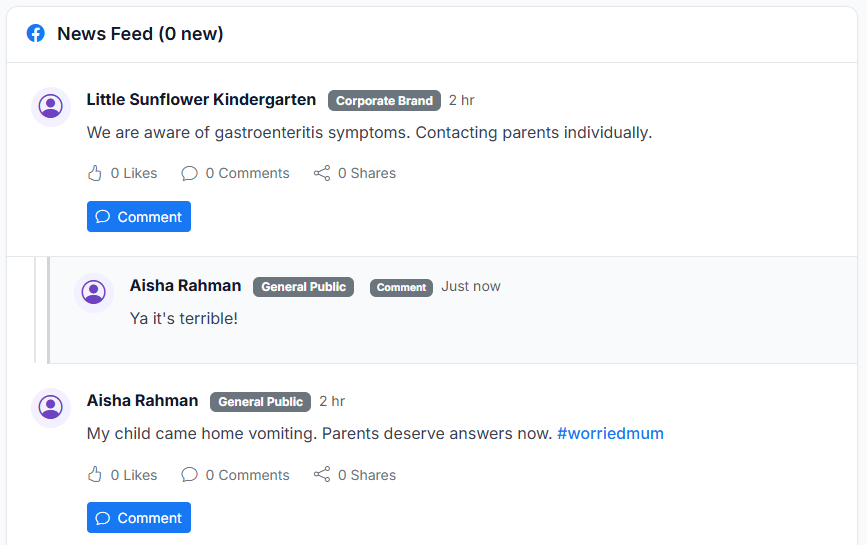
This approach is supported by established learning science. Research consistently shows students significantly improved crisis management competencies after the crisis simulation activity. By repeatedly exposing teams to high-pressure situations, simulations improve their decision-making, sharpen their instincts, and build the confidence needed to act decisively when faced with a real event.
Key Features to Look For in Crisis Comms Training Software
When evaluating crisis communications training software, look for features that deliver realism, flexibility, and actionable insights.
- Scenario flexibility: The software should allow you to create or customise a wide range of crisis scenarios, from an executive scandal or a product recall to a data breach or a workplace safety incident. The best platforms enable you to build simulations that reflect the specific risks your organisation faces.
- Multi-persona environments: A real crisis involves many different actors. The software must be able to simulate these roles, including journalists, regulators, concerned employees, angry customers, and social media influencers. This allows participants to practise engaging with different stakeholder perspectives and demands.
- Multi-channel realism: The simulation should take place across a range of realistic-looking channels, including social media feeds, email inboxes, news websites, and internal chat platforms. This is essential for practising the vital skill of adapting messages and coordinating activity across multiple fronts.
- Real-time interaction: The simulation must be dynamic. Participants should be responding to a situation that evolves based on their actions, not just following a static script. A key feature is the ability for a facilitator to adjust the scenario on the fly, adding new events or injects to increase the pressure and test the team’s adaptability.
- Logging and debriefing: The platform must provide a complete record of the entire simulation. So every message sent, every decision made, and the time it took to act. This log is not just for assessment; it is the foundation for a powerful, evidence-based debrief where the team can review its performance, identify weak spots, and agree on concrete actions for improvement.
Benefits for Internal PR Teams
Integrating simulation software into a training programme provides three core benefits for internal PR teams and their cross-functional partners.
First, it builds muscle memory for crisis response. Just like pilots in a flight simulator, repeated practice makes the core actions of a crisis response; from assessing, writing, approving, to publishing, feel second nature. When a real crisis hits, teams can respond faster and more confidently, because they have been through it before.
Second, it provides a safe space to make mistakes. In a simulation, a poorly worded statement or a delayed response is a valuable learning opportunity, not a brand-damaging disaster. Teams can experiment with different strategies, test their approval processes, and identify weaknesses without any real-world consequences. These mistakes become the building blocks for a stronger, more resilient crisis plan.
Finally, it is the most effective way to train cross-functional teams together. A crisis is never handled by PR alone. Simulations allow you to bring PR, legal, HR, IT, and senior leadership into the same exercise. By working through a scenario together, these teams build the shared understanding, trust, and rehearsed workflows that are essential for a fast and coordinated response during a real event.
Crisis comms simulations are a way to build muscle memory for responders, give a safe space to make mistakes, and train cross-functional teams together.
How Atavra Supports Crisis Comms Training for Internal PR Teams
Atavra is designed specifically to bridge the gap between crisis theory and the practical skills needed to manage a real-world event. It provides a powerful, realistic, and scalable platform for internal PR teams to build the muscle memory and confidence required to navigate the complexities of modern crises.
Overview of Atavra as Crisis Comms Training Software
Atavra is a Software-as-a-Service (SaaS) platform built to simulate realistic crisis scenarios for training purposes. It is designed for trainers, communications agencies, and in-house PR leaders who need to move beyond tabletop discussions and create truly immersive exercises for their teams.
The platform is built to reflect the reality of a modern crisis. Its design is centred around the digital channels and multiple stakeholder groups that define today’s communication landscape. Unlike static plans, Atavra provides a dynamic environment where teams can practise responding to social media, press enquiries, and internal messages in real time. This structure supports repeated, scalable practice, allowing organisations to train different teams and regions with consistent, high-quality simulations.
Building Realistic Crisis Campaigns in Atavra
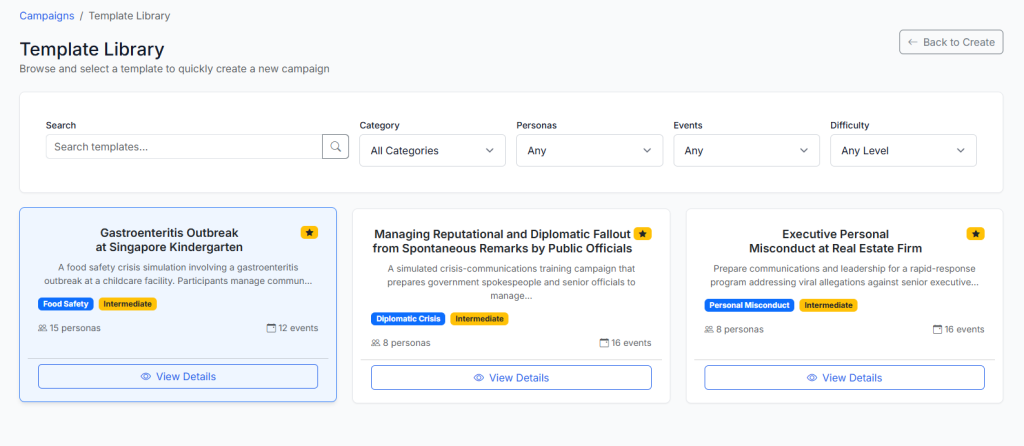
The power of Atavra lies in its ability to create customised and highly realistic crisis scenarios. The process begins with campaign creation, where a facilitator defines a specific crisis, such as executive misconduct, a product fault, a data breach, or a safety incident. At this stage, clear training objectives are set, whether it is to improve decision-making speed, refine the tone of response, or test cross-team coordination.
Next, the facilitator defines the personas involved in the crisis. These can include external actors like journalists from specific media outlets, government agencies, social media influencers, or angry customers. They also include internal actors, such as the PR team, executive leadership, HR, and legal counsel. Assigning participants to these different roles helps them understand the crisis from multiple perspectives and appreciate the competing pressures that different stakeholders face.
Finally, the simulation is brought to life by sequencing campaign events along a timeline. These events mimic how a real crisis escalates. A campaign might start with an initial social media post from an influencer, followed by news articles, critical opinion pieces, questions from employees on internal channels, and formal emails from a regulator. This sequence creates a realistic flow that challenges the team to adapt as the situation evolves.

Running Live Simulations with Atavra
During a live simulation, the participant experience is designed to be as immersive as possible. Users log into a simulated dashboard featuring mock versions of familiar platforms, such as social media feeds, email inboxes, and news sites. As events from the campaign timeline are triggered, they appear on these platforms. Participants, acting as their assigned personas, must then work together to post replies, draft statements, and send internal messages to manage the unfolding crisis.
The simulation is guided by a facilitator, who has full control to adapt the exercise in real time. The facilitator can manually trigger scheduled events to increase the pressure or create entirely new events in response to the team’s actions, adding a layer of unpredictability. They can also assume the role of any persona, such as a persistent journalist or an angry customer, to challenge the participants directly and test their responses. This dynamic control ensures the simulation encourages active teamwork and critical decision-making, as the internal PR team must discuss options, agree on messaging, and coordinate who responds on which channel.
Learning, Debriefing, and Continuous Improvement
The true value of training is realised after the simulation ends. Atavra provides an automatic log of the entire campaign run, creating a complete history of every message, response, timing, and decision. This data is essential for conducting a structured and evidence-based group review.
During the debrief, the team can analyse what went well, such as a fast response time or a consistently empathetic tone. More importantly, they can identify what could be improved, such as approval bottlenecks that slowed them down, or inconsistent messages sent across different channels. This process helps to uncover hidden gaps in existing crisis plans or governance, like an unclear sign-off process or a lack of pre-approved message templates.
This feedback loop allows organisations to build a training programme, not just run a one-off event. With Atavra, teams can re-run scenarios with different variables to test their improvements. Over time, they can develop a library of customised scenarios tailored to their organisation’s specific risks, turning crisis preparedness into a continuous and evolving part of their risk management strategy.
Practical Steps for Internal PR Teams to Get Started
Transitioning from a reactive to a proactive crisis posture requires a structured approach. It begins with an honest assessment of your current capabilities, followed by a clear roadmap for building skills and integrating realistic practice into your regular operations.
Assess Your Current Crisis Readiness
Before you can build a robust training programme, you must first understand your starting point. This involves a critical look at your existing plans, your team’s practical skills, and the specific threats your organisation faces.
First, review existing plans and protocols. Your crisis communications manual should be treated as a living document, not a file that gathers dust. Ask tough questions: Are the roles and responsibilities outlined in the plan still accurate? More importantly, is there a clear and practical chain of approval for issuing statements quickly, including after hours and on weekends? A plan that requires five signatures for a single tweet is a plan that will fail.
Next, evaluate your team’s current skills. Go beyond what people know in theory and focus on what they can do in practice. Have team members ever written a crisis statement or a social media response under intense time pressure? Do they have experience navigating the delicate balance of working with legal and senior leaders during a high-stakes situation? An honest skills audit will reveal the specific gaps that your training needs to address.
Finally, identify the most realistic crisis scenarios for your organisation. A generic training plan is not enough. Your practice should be tailored to the threats you are most likely to face. Consider your sector, geography, and business model. A tech company might prioritise data security and service outage scenarios, while a manufacturing firm might focus on supply chain disruptions or workplace safety incidents. Recent analysis shows that corporate crises are increasingly linked to areas like ESG (Environmental, Social, and Governance) commitments and the conduct of senior leadership, highlighting the need to prepare for a wide range of reputational risks.
Design a Training Roadmap
Once you have assessed your readiness, the next step is to design a training roadmap that systematically builds your team’s capabilities.
- Set clear and measurable objectives. Your goals should be specific and tied to the gaps you identified in your assessment. For example, your objectives could be to “reduce our average time to first public response from two hours to 30 minutes,” “ensure 100% message consistency across all channels during simulations,” or “build leadership’s confidence in the PR team’s ability to manage a crisis effectively.”
- Choose the right combination of training formats. Effective crisis preparedness blends theory with practice. Your roadmap should include foundational training on principles and frameworks, but the core of the programme should be hands-on practice using simulation software. This combination ensures your team not only understands the strategy but has the practical skills to execute it under pressure.
- Finally, involve the right stakeholders from the beginning. Crisis response is a cross-functional effort, so your training programme must be too. Get buy-in from executives, legal, HR, and risk teams by framing the training as a critical component of business continuity and risk management. Work with them to decide who must be involved in simulations and debriefs to ensure the entire crisis response team is aligned and prepared.
Integrate Atavra into Your Crisis Preparedness Programme
With a clear roadmap, you can begin integrating a tool like Atavra to bring your training to life. The key is to start small, learn, and then scale the programme.
A great way to begin is to start with a pilot scenario. Choose a single, high-relevance crisis type and run a focused simulation with your core PR team members. This allows you to familiarise yourselves with the software and the simulation process in a controlled environment. The goal of the pilot is not to be perfect, but to learn how the team communicates and makes decisions under pressure.
Use the insights from the pilot to refine your scenarios based on feedback. After the first simulation, you will have a much clearer idea of what works. You can then adjust the difficulty, the sequence of events, and the personas involved to better match your real-world risks. This iterative process ensures that your training becomes progressively more realistic and challenging.
Once you have refined your approach, you can scale the programme across teams and regions. Atavra’s campaign structure makes it easy to duplicate and adapt scenarios for different business units or markets, ensuring a consistent level of preparedness across the entire organisation. The final step is to make this a continuous process. Schedule crisis simulation exercises on a yearly or bi-yearly basis as part of your ongoing risk management and training cycle to ensure your team’s skills stay sharp and your plans remain relevant.
Turn Vulnerability to Confidence
Being online means being under constant scrutiny, and the difference between a crisis that is managed and a crisis that becomes a catastrophe lies in preparation. An organisation’s ability to respond with speed, empathy, and clarity is no longer a desirable skill but a core business function. For internal PR teams, this means moving beyond theoretical plans and building the practical, real-world capabilities needed to navigate the intense pressure of a reputational threat. This is the shift from a state of crisis vulnerability to one of crisis confidence.
This capability does more than just mitigate damage; it can protect and even strengthen the trust stakeholders place in the brand. An effective crisis response demonstrates competence, transparency, and accountability. When customers, employees, and partners see an organisation handling a difficult situation responsibly, their confidence can be reinforced, turning a moment of vulnerability into a demonstration of the brand’s character and resilience.
By funding and supporting a regular programme of realistic training, leadership sends a clear signal that it takes reputational risk seriously. This commitment builds a more resilient organisation, one that is prepared not only to survive a crisis but to emerge from it with its reputation intact.
Software-powered simulations have removed the traditional barriers to realistic practice. Tools like Atavra.com make it possible to build the skills, confidence, and muscle memory your team needs in a controlled and scalable way.
The path to crisis confidence starts with a single step. We encourage internal PR teams to begin by reviewing their current readiness and identifying the gaps between their plans and their practical capabilities. The next step is to explore how crisis communications training software can professionalise your response and transform your team so that they are ready and not just reactive.
To learn how to build a crisis-ready organisation, visit Atavra.com.