
In 2025, we had the Coldplay kiss cam affair. But in Singapore in late 2026, the drama erupted for a property firm when short videos and screenshots alleging an intimate encounter involving its senior leaders began circulating on social media.
The next day, the firm’s leadership pages and several property listings were taken offline, sparking a torrent of speculation, influencer commentary and emergency media enquiries.
How it started
- Grainy clips and audio snippets first appeared on Reddit and TikTok alleging a personal affair between high‑profile executives.
- Influencers and bystanders quickly re‑posted the footage with captions calling for accountability; within an hour mainstream outlets were seeking comment.
How it escalated
- Social platforms amplified the content: short looping videos, influencer reaction posts and screenshots migrated from niche subreddits to TikTok, Instagram and X (Twitter). Engagement snowballed as followers demanded answers and journalists filed urgent requests.
- The firm’s digital footprint changed visibly — leadership bios were removed and several property listings showed as “unavailable,” which the online conversation interpreted as a tacit admission of disruption.
The company’s response
- Early signs of internal action appeared in staff emails and internal notices telling employees to avoid public comment and offering HR support — a reasonable start for staff welfare but inadequate as an external communications posture.
- Publicly, the company confirmed that the executives had been removed from the leadership pages and that an internal review was underway; some outlets reported resignations and an interim leadership appointment. Coverage from AsiaOne and Bangkok Post captured the swift reputational fallout: https://www.asiaone.com/singapore/propertylimbrothers-melvin-lim-grayce-tan-resign-affair and https://www.bangkokpost.com/business/general/3186798/singapore-property-execs-resign-over-adultery-allegations
Comms under pressure
How would your team handle this? Focus on internal containment first? (staff emails, HR notices). Or issue an external holding statement? In fast‑moving social crises, a short, factual external acknowledgement within the first hour is critical — not to resolve the issue but to demonstrate control and transparency.
Or would you have also quietly removed profiles and listings without explaining why? Digital trace changes are read as actions; if you’re going to take content down, you must simultaneously explain the reason and next steps to avoid feeding rumor.
Immediate response protocols are hard to execute under pressure
- Crises like this unfold across platforms in minutes, forcing organisations to choose between speed and accuracy. An immediate, short holding statement is often the safest first move — but many teams hesitate because they fear saying the “wrong” thing. That hesitation lets others define the story.
Multiple stakeholders complicate decision rights
- A typical firm must align legal, HR, executive leadership and communications — each with legitimate but different priorities (risk mitigation, privacy, regulatory compliance, reputational protection). Getting quick agreement on even a single sentence can be extremely difficult without pre‑agreed escalation pathways and sign‑off thresholds.
Message framing and empathy vs. liability
- Communications must balance empathy for people potentially harmed and the need to preserve legal options. That tension results in cautious, non‑committal language that reads as evasive to the public. Skilled framing — acknowledging impact, committing to due process, and setting clear next steps — requires rehearsal and templates prepared in advance.
Channel strategy and audience dynamics
- Social media audiences and journalists have different expectations. Social users demand immediacy and emotional candour; newsrooms expect verification. Organisations that treat channels as afterthoughts (e.g., only using email for staff and waiting to craft a press release) will lose credibility. Coordinating synchronized messages across platforms — and preparing spokespeople for live interviews — is operationally complex.
This could happen to any organisation. The common denominator is a lack of practiced, cross‑functional response. Most PR teams have drafted statements but never rehearsed them under realistic pressure with legal, HR and executive stakeholders in the room.
Preparation is the only defense. Teams that have never practiced a coordinated crisis response will discover gaps in decision rights, timing and message discipline when the story breaks for real.
Run a crisis simulation based on this incident
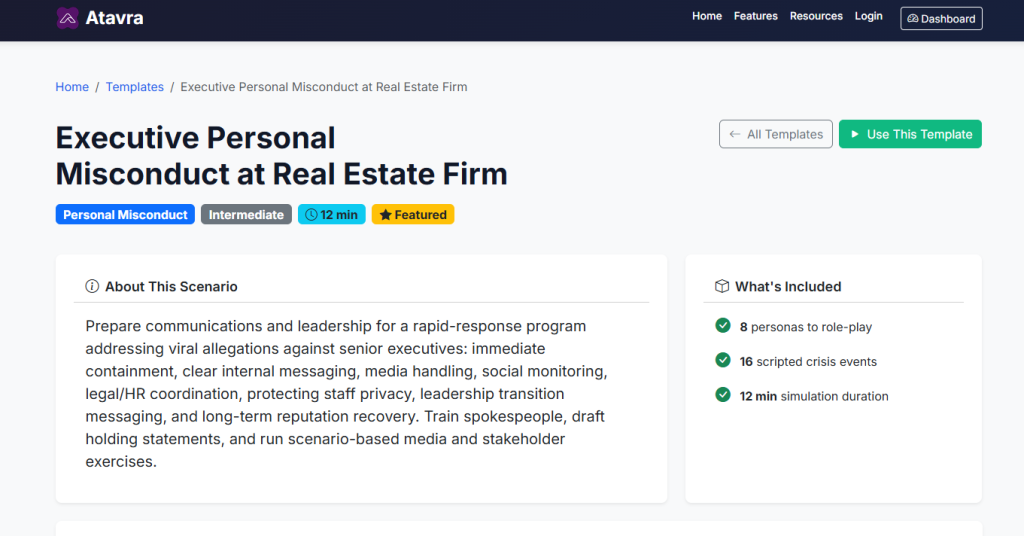
Leadership crises can explode in hours. Their responses are often improvised. Yours doesn’t have to be.
Atavra lets your team experience a scenario just like this one—complete with stakeholders, escalating events, and the pressure of real‑time decision making.
Your executives, legal team, PR staff, and social media managers will practice coordinating their response before the stakes are real.
Simulation template includes:
- Persona types: legal counsel, social media manager, CEO/executive, head of HR, corporate communications lead, influencer, business journalist
- Event types: a viral short video (TikTok/Reddit) goes viral, influencer reposts, journalists file urgent comment requests, leadership profiles/listings taken offline, internal staff emails and external holding statement timing